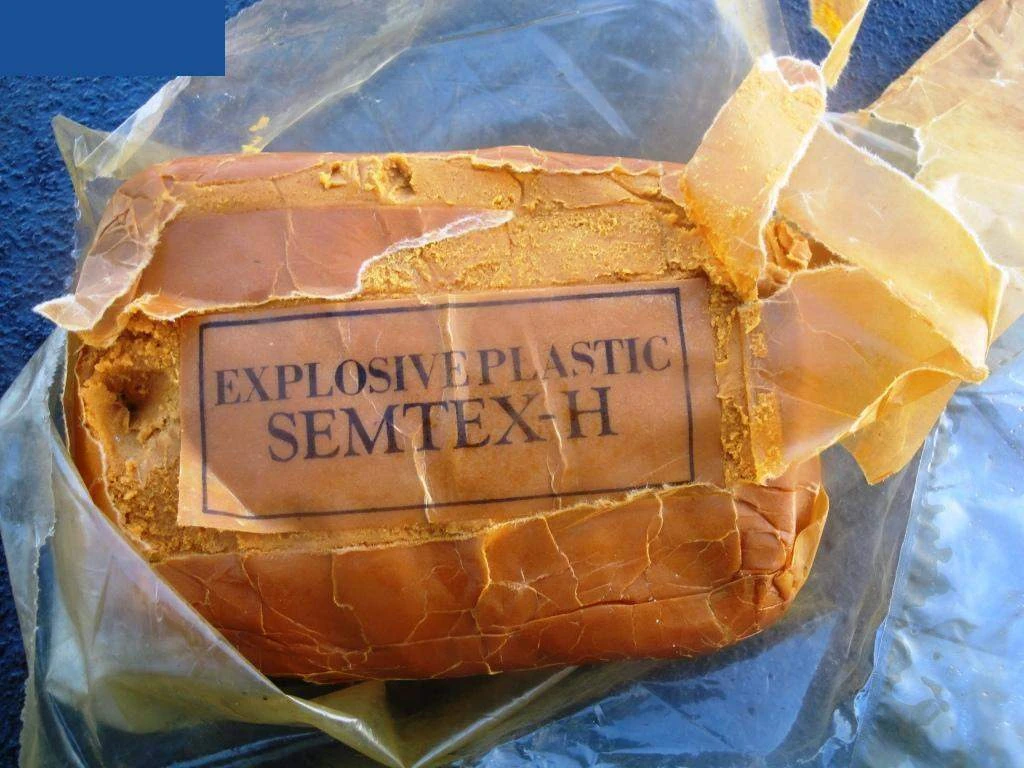

Explosive plastic Semtex-H
An Explosive (or Explosive Material) is a reactive substance that contains a great amount of potential energy that can produce an explosion if released suddenly, usually accompanied by the production of light, heat, sound, and pressure. An Explosive Charge is a measured quantity of explosive material, which may either be composed solely of one ingredient or be a mixture containing at least two substances.
The potential energy stored in an explosive material may, for example, be
- chemical energy, such as nitroglycerin or grain dust
- pressurized gas, such as a gas cylinder, aerosol can, or BLEVE
- nuclear energy, such as in the fissile isotopes uranium-235 and plutonium-239
Explosive materials may be categorized by the speed at which they expand. Materials that detonate (the front of the chemical reaction moves faster through the material than the speed of sound) are said to be "high explosives" and materials that deflagrate are said to be "low explosives". Explosives may also be categorized by their sensitivity. Sensitive materials that can be initiated by a relatively small amount of heat or pressure are primary explosives and materials that are relatively insensitive are secondary or tertiary explosives.
A wide variety of chemicals can explode; a smaller number are manufactured specifically for the purpose of being used as explosives. The remainder are too dangerous, sensitive, toxic, expensive, unstable, or prone to decomposition or degradation over short time spans.
In contrast, some materials are merely combustible or flammable if they burn without exploding.
The distinction, however, is not razor-sharp. Certain materials—dusts, powders, gases, or volatile organic liquids—may be simply combustible or flammable under ordinary conditions, but become explosive in specific situations or forms, such as dispersed airborne clouds, or confinement or sudden release.
History
At its roots, the history of chemical explosives lies in the history of gunpowder. During the Tang Dynasty in the 9th century, Taoist Chinese alchemists were eagerly trying to find the elixir of immortality. In the process, they stumbled upon the explosive invention of gunpowder made from coal, saltpeter, and sulfur in 1044. Gunpowder was the first form of chemical explosives and by 1161, the Chinese were using explosives for the first time in warfare. The Chinese would incorporate explosives fired from bamboo or bronze tubes known as bamboo fire crackers. The Chinese also inserted live rats inside the bamboo fire crackers; when fired toward the enemy, the flaming rats created great psychological ramifications—scaring enemy soldiers away and causing cavalry units to go wild.
Though early thermal weapons, such as Greek fire, have existed since ancient times, the first widely used explosive in warfare and mining was black powder, invented in 9th century in China by Song Chinese alchemists. This material was sensitive to water, and it produced copious amounts of dark smoke. The first useful explosive stronger than black powder was nitroglycerin, developed in 1847. Since nitroglycerin is a liquid and highly unstable, it was replaced by nitrocellulose, trinitrotoluene (TNT) in 1863, smokeless powder, dynamite in 1867 and gelignite (the latter two being sophisticated stabilized preparations of nitroglycerin rather than chemical alternatives, both invented by Alfred Nobel). World War I saw the adoption of TNT in artillery shells. World War II saw an extensive use of new explosives (see List of explosives used during World War II). In turn, these have largely been replaced by more powerful explosives such as C-4 and PETN. However, C-4 and PETN react with metal and catch fire easily, yet unlike TNT, C-4 and PETN are waterproof and malleable.
Gate - Thus the JSDF Fought There
The explosives that are seen being used by JSDF are the C-4 (Composition C-4) and the Detonating Cord.